The Beginning of American Motors Corporation: Ep1: The Last Independent Automaker
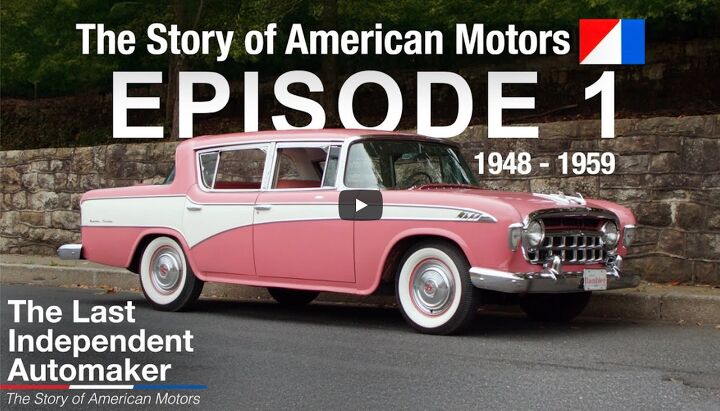
In the brutally competitive post-WWII car market, two smaller companies merge to take on Detroit's BIG THREE. President George Romney revolutionizes the industry with a new idea: "compact" cars.
The Last Independent Automaker is a six-part documentary series, produced by Joe Ligo, Jimm Needle, and Patrick Foster. It details the dramatic rise and fall of American Motors Corp., told through over 35 exclusive interviews, hundreds of rare photographs, and hours of historical and new automobile footage.
The TTAC Creators Series tells stories and amplifies creators from all corners of the car world, including culture, dealerships, collections, modified builds and more.
An AI-generated transcript edited by a human staffer is below.
[Image: YouTube Screenshot]
Become a TTAC insider. Get the latest news, features, TTAC takes, and everything else that gets to the truth about cars first by subscribing to our newsletter.
This transcript tells the early history of American Motors Corp. (AMC), focusing on how it emerged from struggling independent automakers and survived against the dominance of the “Big Three” — General Motors, Ford, and Chrysler.
Main story and themes
- The documentary begins in 1948 when George Mason recruited George Romney away from Packard to join Nash-Kelvinator. Mason mentored Romney and prepared him to eventually lead the company.
- At the time, most American car sales were dominated by the Big Three, leaving smaller “independent” automakers such as Nash, Hudson, Studebaker, Packard, Kaiser, and Willys struggling to survive.
- Mason believed the independents needed to merge in order to compete. His strategy centered on smaller, more efficient cars rather than trying to outmatch Detroit’s giants in size and luxury.
The Rambler and the “compact car”
- Nash introduced the Nash Rambler, a smaller and more fuel-efficient car than most American vehicles at the time. Romney coined the term “compact car” to avoid the stigma associated with “small cars,” which Americans viewed as cheap or low-status.
- The Rambler succeeded because it appealed to suburban families looking for economical second cars while still offering comfort and style.
- AMC marketed the Rambler as practical, easy to park, fuel-efficient, and modern — a contrast to the increasingly large and gas-hungry vehicles produced by the Big Three.
Formation of AMC
- As competition intensified and sales slowed in the early 1950s, the independent automakers struggled financially. Hudson in particular suffered because it lacked the resources to redesign its aging models and develop a V8 engine.
- In 1954, Nash-Kelvinator merged with Hudson Motor Car Co. to create American Motors Corp., at the time the largest corporate merger in U.S. history. Mason named the new company himself.
- The merger consolidated operations in Kenosha, Wisconsin, and many Hudson models became rebadged Nash vehicles, which critics mockingly called “Hashes.”
George Romney’s leadership
- After Mason died unexpectedly in 1954, Romney fought to become AMC’s leader despite resistance from the board.
- Romney made the bold decision to abandon AMC’s larger Nash and Hudson cars and focus almost entirely on Rambler models. He aggressively cut costs and restructured the company to survive.
- Even during severe financial losses, Romney strongly believed Americans would eventually prefer smaller, more economical cars.
Economic changes and AMC’s turnaround
- AMC nearly collapsed during the mid-1950s price wars started by the Big Three, but the 1957 recession unexpectedly helped Rambler sales because buyers began seeking cheaper and more fuel-efficient cars.
- AMC’s strategy finally paid off:
- The Rambler became increasingly popular.
- AMC returned to profitability by 1958.
- Sales doubled by 1959.
- Romney became a celebrated figure in Kenosha and across the industry for saving AMC through discipline, marketing, and a focus on compact cars.
Broader social context
The documentary also highlights:
- Immigrant and African-American workers entering the auto industry after World War II.
- Difficult factory conditions and the role of the UAW union in protecting workers.
- The dependence of entire communities like Kenosha on automobile manufacturing jobs.
Overall conclusion
The transcript portrays AMC as an underdog company that survived by being different. Rather than competing directly with Detroit’s giants in horsepower and luxury, AMC succeeded temporarily by predicting the demand for smaller, practical cars before the rest of the industry caught on. It ends by foreshadowing future challenges, including competition from foreign imports and the Big Three’s own compact cars.
from TheTruthAboutCars https://ift.tt/QlnkgqM
via IFTTT
No comments