Opinion: The Auto Market Is Slowly Crashing

Ever since new vehicle prices started to part with economic reality, everyone has been asking each other when the auto market will finally crash. Based on mounting evidence, that day finally looks to have arrived. But calling it a crash could be a mistake, when it really looks to be more of a carefully managed long-term market decline.
Toyota, which is the largest global automaker by volume, has been struggling all year. Despite remaining dominant inside North America, the company recently announced that global sales had declined by 7.2 percent (year-on-year) to 834,279 vehicles.
In the report, the company noted that Chinese volumes had declined by 31.7 percent with the Middle East being down 38.6 percent. The former was attributed primarily to the popularity of Chinese EVs and elevated fuel pricing, whereas the latter could be a combination of economic factors and regional conflicts.

While Toyota enjoyed a domestic sales boom in Japan, this was not enough to offset global losses. It likewise needs to be said that Toyota had done well in the United States thanks to its reputation and ability to field a large number of hybrid models ahead of surging fuel prices. Toyota was already the top-selling brand in the U.S. and looks to be poised to surpass General Motors in terms of overall sales. But this did not prevent the company from seeing U.S. volumes decline by 0.6 percent, arguably showcasing just how bad things have gotten.
It’s undeniable that the North American market is retracting. We’ve seen volumes shrinking pretty consistently since last fall. While many have pointed to the U.S. government ending federal tax credits for the sharp decline in electric vehicle purchases, the scheme was always supposed to be a temporary measure to help boost EV volumes while the technology was still in its infancy. But it turned into a decadelong program to subsidize the sale of what were often relatively expensive automobiles.
One could argue that EV tax credits and government initiatives to fund the supporting infrastructure were artificially propping up the market to begin with. Automakers have noted billions in losses stemming from EV-related investments over the last several years. While it looks like electrics will persist on developed markets, the planned transition to EVs has clearly failed to take place within the desired timeframe. This has left the industry in an unenviable position, as it now has to refocus development on the kinds of vehicles most were hoping to abandon.
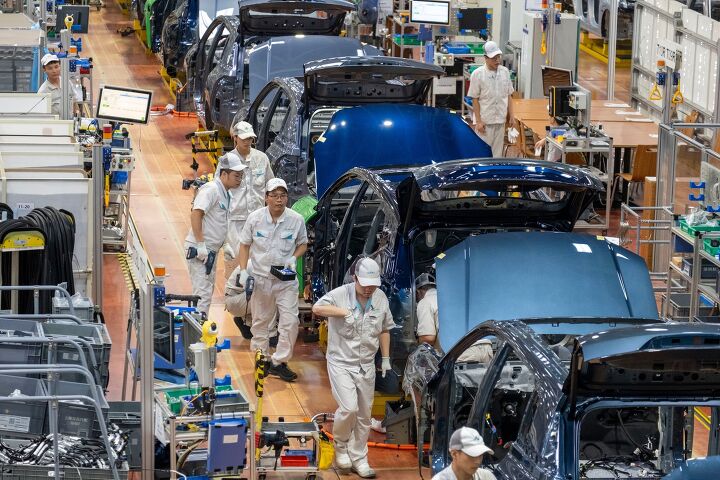
China, which effectively controls global battery supplies, is a big part of this. It’s been fielding highly competitive all-electric models at prices legacy manufacturers appear unable to compete with. Combined with the region prioritizing its own domestic automakers, this has been abysmal for foreign brands vying to compete on the market.
Many automakers are likewise trying to pivot away from volume to chase higher margins per unit sold. We’ve seen this manifest for over a decade by way of brands culling smaller, affordable models from their lineups and introducing subscription models that help ensure consistent revenue streams. Data harvesting has also become ubiquitous across the industry, helping companies make money by effectively keeping tabs on their own customers and then selling that information to third parties.
But this is one of those chicken or the egg scenarios. Did volumes decline because so many automakers started to focus on expensive vehicles and novel revenue streams or are they simply trying to adjust to markets that had become highly saturated?
We’d argue that the answer is yes on both counts. However, claiming that Western markets had already achieved peak saturation seems incorrect when the average American is now driving something that was built nearly 15 years ago. We’ve also seen countless studies suggesting that elevated car prices have effectively forced millions of drivers out of the new-vehicle market.

Ten years ago the average transaction price for a new automobile was about $33,500. Today that figure is roughly $50,000. In terms of new vehicle sales, we can see that automakers delivered an estimated 17.5 million new cars and light trucks in 2015. That number was 16.4 million units in 2025, despite the U.S. population having grown by over 20 million people over that same period. A healthy economy does not typically see a decline in new vehicle sales as the population increases.
Sustained inflation, new tariffs, aggressive regulations, and supply chain issues have all contributed — and we’re happy to address those factors. But they aren’t great excuses and mentioning them certainly doesn’t change the reality where significantly fewer people can afford to purchase a new car.
It likewise doesn’t eliminate the fact that countless developing markets are still issued vehicles that are far simpler and significantly more affordable than what we’ve been handed. Granted, many of these would be poorly suited to Western tastes and may not even pass many U.S. regulations (which could be a problem in itself). But it’s undeniable that there’s a meaningful subset of our market that just wants cheap, reliable transportation.
We don’t want any of the above to make you assume that it’s exclusively Western markets that are seeing retracting volumes. Because things could be looking better globally, too.
Worldwide, volumes are anticipated to retract by as much as 3 percent this year. Analysts from S&P Global Forecast attributed this to rising energy costs and growth in China appearing to have plateaued after years of aggressive growth. Others have stated that the issue is that developed markets (e.g. Europe) never fully recovered from the declining volumes witnessed during the early 2020s.
As for the United States, we’re seeing a lot of overlap with the last big recession. Subprime auto loan delinquencies are now higher than they were during the 2008 financial crisis, which included an auto market crash. Over 30 percent of all U.S. trade-ins also carry negative equity, effectively keeping those drivers in perpetual debt. Meanwhile, vehicle repossessions are estimated to occur at a rate of about 3 million annually — almost double what they were in 2008.

Looking into the future, it’s similarly hard to see a quick turnaround. Fewer young Americans are bothering to get a license than in past decades and make significantly less money than their parents did at the same ages. Some have estimated that this could reduce annual new vehicle volumes by another 2 million units by 2040.
Automakers have also been slashing a significant number of jobs. The exact number is difficult to pin down. But most legacy brands have announced rolling layoffs since 2019, resulting in an estimated 90,000 fewer direct manufacturing and supplier jobs in North America alone. Some of that was undoubtedly due to the fumbled pivot to EVs. But manufacturers had assumed electrification would have required fewer human hands and we’ve seen a lot of planned EV factories being scrapped anyway.
Globally, the number of lost positions is expected to be significantly higher. Volkswagen is presently considering a restructuring plan that could result in the elimination of 100,000 jobs. That’s on top of the layoffs it had already enacted over the last several which had helped make Germany the number one country for industry related job cuts. All told, it’s assumed that the nation has reduced vehicle manufacturing by about 120,000 jobs since the start of 2020.
Japanese brands, which have performed significantly better overall, aren’t immune to this. Nissan is assumed to dump about 15 percent of its total workforce as part of its own restructuring efforts.

The retail side of equation has been changing, too. Formerly nonexistent discounts are back on the menu at some dealerships. CarMax has also reportedly started bringing down prices on used models after announcing that it had taken a sizable hit to its share price earlier this year. While showrooms seem more willing to cut you a deal than before, MSRPs and interest rates remain high as wages have been largely stagnant.
Perhaps the biggest tragedy of this whole situation is that there doesn’t yet seem to be the kind of market correction that actually helps consumers at the manufacturing level. But the situation is evolving and automakers are typically slow to change course.
In the wake of the Great Recession of 2008, automakers were absolutely desperate for sales and started to introduce scads of smaller economy models to help drive volume. Dealers were likewise prepared to offer steep discounts to get you into something. The government even introduced “Cash 4 Clunkers,” a nationwide scrappage program designed to eliminate used vehicles by effectively paying their owners to buy new models. The recession period also saw a staggering number of domestic factory jobs being eliminated and additional government assistance by way of financial bailouts.
While many of us thought that some of those government-backed initiatives were an abomination that taught all the wrong lessons, the above still highlights just how desperate the industry was for fresh business back then. By contrast, today’s automakers continue to act as though they can keep expanding per unit margins to more than make up the difference as they streamline the workforce.

Today’s layoffs may help reduce overhead. But the industry is also just making even more people that cannot afford to buy vehicles tomorrow. Were it not for the accompanying financial pressures being directed at consumers, this probably wouldn’t be that detrimental. However, automakers really do seem to be obliterating their good will with a public that is starting to view them as increasingly predatory. While we can debate whether leadership is doing this intentionally, it presumably won’t have much bearing on public sentiment.
Still, even if we ignore that, it might not have much bearing on the present situation. With even the most conservative of estimates suggesting that the average household has lost nearly 10 percent of their annual purchasing power since 2019, spending more is out of the question. Sadly, it seems that the industry’s solution has been to aim even higher while expecting low-income buyers to accumulate more vehicle debt.
Americans are currently carrying a total of $1.69 trillion in auto loan debt. That breaks all previous records and makes it the second largest financial burden in the country after mortgages. Were vehicles not typically a deprecating asset, one might be able to make the argument that this is somehow sustainable. Since they are not, one must assume that the present situation is untenable.
That makes the market crash inevitable, assuming it’s not already happening. But that could be good or bad news depending upon how it’s managed.
Right now, nobody really seems to walk to discuss the issue. The term crash hints at panic that leads to reactionary measures that often worsen the problem. Automakers are issuing major restructuring plans to address declining volumes, perhaps avoiding disaster further down the line.
However, we do not yet know if that will yield saner pricing and more customer-friendly designs or the industry doubling down on predatory financial schemes and even more high-margin vehicles brimming with tech features that only seem to complicate ownership.
We’ve been promised a little of both over the last few years. Many brands have suggested that they’ll soon be introducing affordable models, while also staying focused on the tech game. Automakers can also see volumes starting to decline and don’t want to spook their shareholders, so they’re making bold proclamations about how they absolutely must improve per unit margins in the coming years.
While we doubt that’s something every brand can succeed at when there are so many automakers fighting over shrinking slices of pie, it’s the direction plenty of OEMs seem to be heading. That leaves one hoping that there are brands shrewd enough to once again attempt to field something for the masses, potentially making itself a fortune during the recovery phase. Historically, not doing this has resulted in massive levels of consolidation as smaller brands are absorbed into the larger entities or simply go out of business during the economic downturn.
Regardless, we wouldn’t recommend you worry any more than you already have been. Crash or no, the global car market has been absolutely goofy since 2020 and it seems like these novel business models exist largely at odds with the last 100 years of global commerce. If you've made it this far, the odds are good you can handle whatever comes next.
[Images: Keegan Divant/Shutterstock; Toyota; Ringo Chiu/Shutterstock; Michael Vi/Shutterstock; Chris Fotoviajero/Shutterstock; The Image Party/Shutterstock; Paul Brennan/Shutterstock; John Gress Media Inc/Shutterstock]
Become a TTAC insider. Get the latest news, features, TTAC takes, and everything else that gets to the truth about cars first by subscribing to our newsletter.
from TheTruthAboutCars https://ift.tt/cH0n5Tu
via IFTTT
No comments